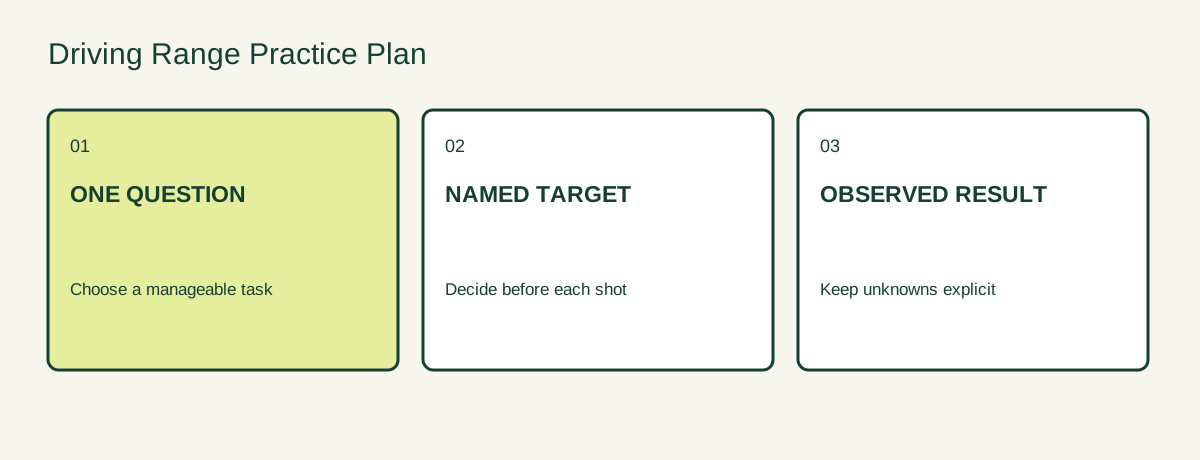
A useful driving range practice plan gives each small group of balls a job. Choose one question, name a target, leave time between shots and record what you actually saw. The bucket size is a limit, not an instruction to hit every ball. This guide offers an original planning sheet, not a swing diagnosis or a promise of lower scores.
You might arrive with a wedge, an iron and a longer club, yet spend the entire visit switching clubs after each disappointing shot. Before starting, write a question narrow enough to observe: “With this iron and this target, where does the ball usually start?” That produces a more usable note than “fix my golf.” A PGA professional can help choose the technical work when you do not know what needs changing.
Before opening the bucket
Check the facility's instructions, hitting area, targets and closing time. Keep people and belongings outside the swing area. Follow staff instructions about mats, tees and alignment aids. Do not step beyond the hitting area to retrieve balls or equipment. Pause when anyone enters the space you need to swing.
Choose clubs you can use comfortably today. There is no requirement to include a driver, hit a full swing or finish a large bucket. If you feel pain, dizziness or another concerning symptom, stop rather than trying to correct it through more swings. Ask a qualified health professional about symptoms and a qualified coach about technique.
An example allocation, not a prescription
The following is an invented 30-ball allocation for organising a visit. It is not a validated training dose. Adapt it to your ability, comfort, coaching advice and the facility. Unused balls are an acceptable outcome.
| Group | Example allowance | One job | What to record |
|---|---|---|---|
| Settle in | Up to 6 | Comfortable shots toward an identified target | Whether the setup is comfortable |
| Focus block | Up to 12 | One club, one question, a target chosen for that club | Start direction and observable result |
| Change the task | Up to 6 | Choose a different target or club deliberately | The decision before each shot |
| Return and review | Up to 6 | Revisit the original question if comfortable | What stayed similar and what remains unclear |
The allowances add to 30. They do not imply that all four blocks must be completed. If a coaching session already gives you an allocation, use that instead of stacking this plan on top. A short visit can consist of settling in, one focus block and a note.
Give the focus block one observable question
Name the target before each shot. Describe the result in language you can repeat: started left of the target, landed short of the chosen marker, or could not judge the landing. “Unknown” is useful when visibility is poor. It is more honest than assigning a distance you could not see.
Keep club selection separate from swing experiments. Changing club, target and a technical instruction at once makes the next result difficult to interpret. If you are working on a coach's instruction, record that exact instruction rather than adding several new tips from memory. Do not diagnose the cause of a miss from a single ball flight.
Change the decision, not just the club
In the next block, decide on a target and club before stepping into position. The purpose here is to practise making a choice rather than collecting rapid repetitions. Keep your normal preparation between shots. A different target does not have to mean a longer or harder shot.
PGA coach Brendon Elliott's range-session article uses designated targets, a pre-shot routine and course simulation as parts of purposeful practice. His student example is not the allocation above. Our worksheet is an editorial way to record a smaller task; it does not reproduce his session or claim his endorsement.
End with a note you can use next time
Record the date, facility, club, target, question, approximate balls used and visible observations. Add conditions that affected what you could judge, such as a mat or poor visibility. Range-ball flight and marked targets do not by themselves establish a measured on-course carry distance.
An example note might read: “Invented example: six shots with the same iron; four visibly started right of the chosen marker; landing distance unclear. Ask the coach whether my setup matches the task.” That is an observation and a question, not a fault diagnosis. Do not write that a session improved your scores before you have relevant evidence.
Use the original session record
Download the blank range session CSV. It contains no sample scores or preset improvement target. Use one row per task, and leave unobservable results blank or label them unknown. Keep a short free-text note if a numerical count would distract you.
Use the three-target distance-control guide when choosing target tasks is the actual question. The range notebook guide covers longer-term note taking. This page is the allocation step: decide what today's bucket is for, then stop when the useful work is finished.