
A search for “golf practice carpet” can lead to several different products. Decide whether you want a surface for rolling putts, a designated area for striking a ball, or one replaceable part of a larger setup. Those jobs are not interchangeable. Check the exact product's intended use and installation instructions before comparing its size or price.
The footprint tool below compares two rectangles only. A mat that fits on the floor does not establish room for a golfer, a club's movement or a ball's path. It does not approve indoor hitting, select a net or certify a safe practice area. If the complete setup cannot meet the relevant instructions, do not swing there.
Name the practice task before the product
For putting, the useful question concerns a rolling surface and the space needed for the planned putt. For hitting, you need to understand the manufacturer's intended shots, the surface beneath the mat and the rest of the installation. A small hitting insert may be a component rather than an area on which the golfer stands.
The FORB golf-mat catalogue lists distinct putting mats, hitting mats, stance replacements and other practice surfaces. Its product groupings illustrate why the word “carpet” alone is not a complete specification. They do not establish that any item is suitable for your home, equipment or level of use.
Write down the job in a sentence: “I want to roll short putts using an appropriate surface” or “I am checking the requirements for a manufacturer-approved hitting setup.” Avoid turning a product photograph into an installation plan. The background shown in an advertisement may not match your floor, ceiling, surroundings or intended shot.
Read the exact size and what it includes
Record the outside dimensions of the exact size option you are considering. Do not confuse a hitting strip with the combined stance-and-hitting area or a mat with a complete practice enclosure. If the listing has separate pieces, record each one and ask which components are required together.
Use one unit consistently. Inches entered beside centimetres will produce a meaningless answer even when the arithmetic runs correctly. Measure the usable rectangle where the mat would lie, leaving obstructions outside it. Record doors, furniture and other constraints separately rather than silently treating their occupied area as available.
Product dimensions are not swing-clearance dimensions. Do not subtract a mat's footprint from a room's area and interpret the remainder as a safe allowance for movement. Room shape, height, the golfer, the club and the complete system's instructions all matter beyond this worksheet.
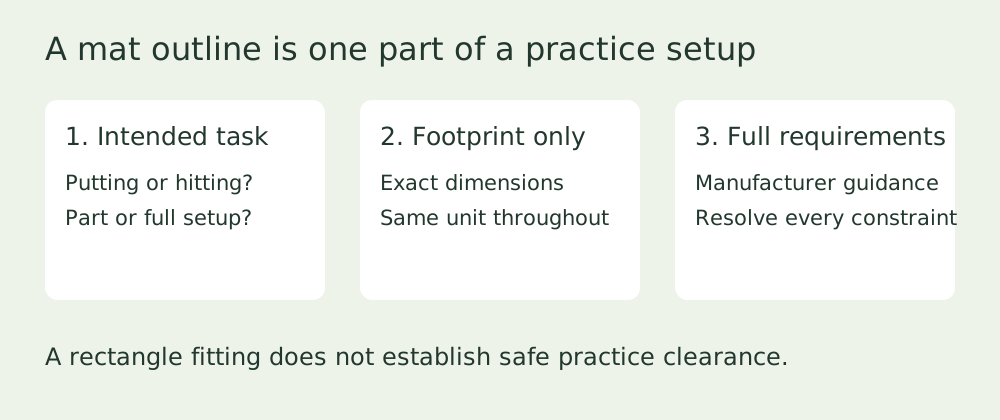
Use the rectangle check for one narrow question
The mat footprint worksheet asks for the mat's length and width and the measured rectangle's length and width. It checks the listed orientation and a ninety-degree rotation. A positive result means only that the rectangular outlines fit within the entered dimensions, with no additional clearance allowed.
In a fictional example using centimetres, a 150 by 100 mat does not fit in the listed orientation inside a 120 by 160 rectangle. Rotating the mat makes the outline fit. That does not mean you can practice from either orientation: the product's design or instructions may prohibit rotating it relative to the rest of the setup.
An exact edge-to-edge fit is also only a mathematical result. It provides no installation tolerance, access space, standing area or safety margin. The tool deliberately does not invent a universal extra distance. Write the applicable installation requirements into the separate record and resolve them with the manufacturer when necessary.
Compare construction claims without inventing a test
A listing may describe turf material, backing, thickness, replaceable sections or the use of a particular tee. Copy the relevant specification and its source date into your comparison record. Keep seller claims distinct from results you have personally established. We have not tested the products mentioned in this guide.
For example, Parbuster's commercial hitting-mat page provides a product description and options for that mat. Use a current product page to check the exact option and applicable terms, rather than transferring a feature or a review from another model. A product name containing “commercial” does not by itself answer your home-installation questions.
If two candidates use different descriptions for thickness, backing or included components, ask for clarification before treating the numbers as comparable. Do not infer comfort, durability or injury prevention from a single dimension or a short review. A familiar-looking green surface is not proof of equivalent construction.
Include storage and maintenance in the decision
Check whether the product can be rolled, folded, moved or left in the intended location, and what the maker says about the supporting surface and storage conditions. Do not assume that a putting mat and a hitting mat share the same storage method. A product that cannot be stored as directed may be unsuitable even when its outline fits.
Read cleaning instructions and replacement-part information for the exact product. Record the delivered price, what is included and the return conditions before ordering. Large or heavy items can have a different return process from a small accessory. The worksheet leaves those fields open because there is no single policy for all sellers.
Keep equipment planning separate from practice advice
If a home setup remains unresolved, an appropriate established practice facility may be the simpler option. Our first driving-range guide covers that separate visit, while the putting-green routine addresses a different practice situation. Neither link validates a home installation.
Finish the comparison with an explicit unresolved list: intended use, full installation, exact components, maintenance and returns. Buy only when the relevant information is clear enough for your situation. A useful outcome can be deciding that you need a different surface or no home mat at all, rather than forcing a purchase because one rectangle passed the calculator.